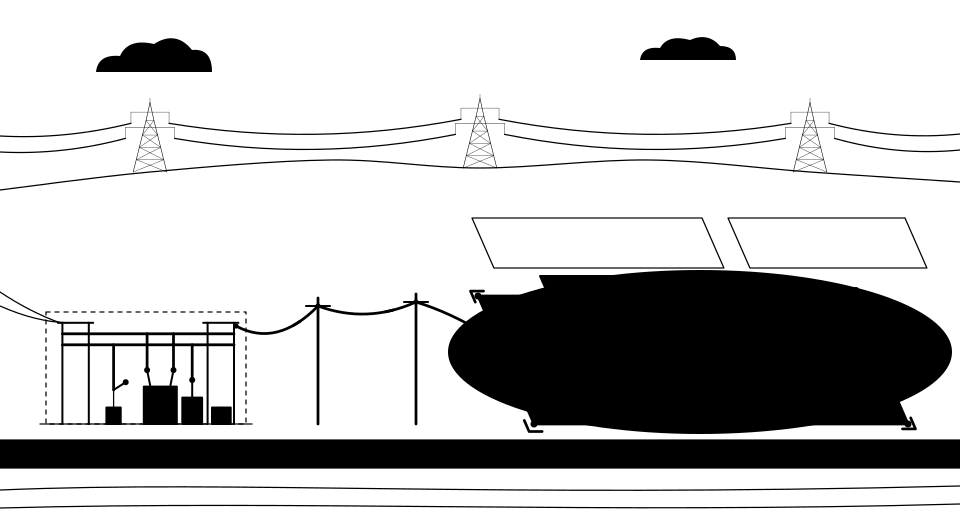
The value of a site rests on how credible its development path is, not on how close it sits to a substation. Two parcels can share a fence line and the same wires, and the one that sells for far more is the one where a project can actually be built: its power, its approvals, the condition of its ground, the infrastructure around it and the economics of the project line up, and a buyer can see that they do.
Energy.LLC buys industrial property and develops it with owners, and we read every property that way, because we know what can stop a project.
A line nearby is not power for a project.
The wires along a road carry power to the customers already on them, and a substation serves the loads it was built for. A data center or a large energy project is a new load of a different order; the capacity it needs has to be planned and built for it, and that work, and the time it takes, are what any date rests on. A property with service already in place has a better starting point, and only that: the service it has today establishes neither the capacity a new use needs nor the date it arrives. That is why Energy.LLC states a site's power as it stands: what exists is stated, and what is planned is labeled as planned until it is built. The distance from a parcel to a substation says where the conversation about power begins, and nothing about where it ends.
Value is made where the open questions are answered.
What a buyer pays for is the distance between a property and a project, measured in questions still open. The approvals are the town's to give, and a use the zoning does not allow, or a restriction under consideration, holds a project in place however strong the wires. The ground has to carry a building and handle its water, and an environmental history that is not yet understood is a cost no one can size. The infrastructure a project depends on, beyond its wires, has to reach the site in time. And the economics have to work: a finished site has to be worth what it costs to make it, in a market that wants it.
Each question answered moves a property closer to a project. A site with every question open is a possibility; a site with its questions answered is a project waiting for its operator, and it is priced as one.
Two parcels that look alike on a map are not alike.
Put them side by side: the same size, the same distance to the same substation. One is zoned for the use, holds clean title, has a building standing on ground that drains, and sits in a town that has known its owner for years. The other carries a right-of-way across its middle, an environmental history still in the files and a restriction the town is debating. The first can carry a project to a date an operator can plan on; the second cannot yet, and every open question on it is a risk the buyer prices, or work the buyer does, before it is worth what the first one is. A map shows two parcels and a substation, and nothing of what separates them.
Headline prices describe sites whose questions were answered.
The figures that reach the press come from markets where the industry has built for years, where operators, fiber, workforce and service are in place and much of a site's path was settled before the sale. They are real, and they describe what a site is worth once its questions are answered. A property whose path is still open is a different property, and the headline is a fact about a different site. An owner is right to read those figures; the useful question is what they rested on, and whether the same can be made true here.
An owner can make the path more credible.
Much of what makes a path credible is in the owner's hands before any developer arrives. The record can be assembled: title and what encumbers it, the property's environmental history, the condition of the building and ground, and the service in place today. The town can be engaged early, and an owner it has known for years brings a standing no newcomer has. And the options can be kept open: selling settles the matter now and passes the work and the risk to the buyer, while a joint venture keeps the owner in the property while its questions are answered, with development capital behind the work. Our page on landowner joint ventures sets out what each choice means.
The developer's work is where the value is built.
The developer's work is what Energy.LLC does. With our proprietary, parcel-level intelligence we read a property against each of those questions and take on the properties whose answers hold up, by buying the property or developing it with its owner. What follows is development: the approvals carried with the town, the power taken from a plan to service in place, and the ground, the infrastructure and the economics worked through until an operator takes the site. That work is where a site's value is built, and the property form on our acquisitions page is where it starts.
Questions this note answers
Is land near a substation worth more?
Not by itself. Being close to a substation sets where a site's power conversation starts, and a buyer pays for how far along the whole path the site is. The capacity a project needs has to be planned and built for it, and the approvals, the ground, the infrastructure and the economics each have to line up as well. A parcel whose path through those questions is credible is worth more than one whose path is open, whichever of the two sits closer to the wires.
My factory has a substation on site. Is it worth more as a data center site?
Service in place and a standing building are a real head start: the structure saves the time it would take to raise one, and existing service is a better starting point than none. Neither establishes the capacity a new use needs or the date it arrives, and the approvals, the ground and the economics are worked through as on any site. What the property is worth as a data center or energy site is decided by that path, and an owner who can set out the building, the service as it stands and the property's history has given a buyer the facts needed to read the property.
Are the prices I read about for data center land what my land is worth?
Those prices describe a different property: one whose approvals, ground, infrastructure and service were settled before the sale, in a market that had already built for years. Yours is priced on the work and the risk that remain, and the gap between the two figures is the development path itself. The useful reading of a headline is what the site behind it rested on, and whether the same can be made true of yours.
Who pays for the work that makes a site valuable?
The developer who takes the site on. In a sale, Energy.LLC buys the property, sits on the buyer's side of the table, and the work and the risk pass to us. In a joint venture, the owner stays in the property while its questions are answered, with development capital behind the work and our developers carrying it, and what the project creates is shared on terms agreed for each property. In either case everything goes in writing, and we like your lawyer in the room.
Bring us the property, and we will tell you what its value rests on.
Send an inquiry